
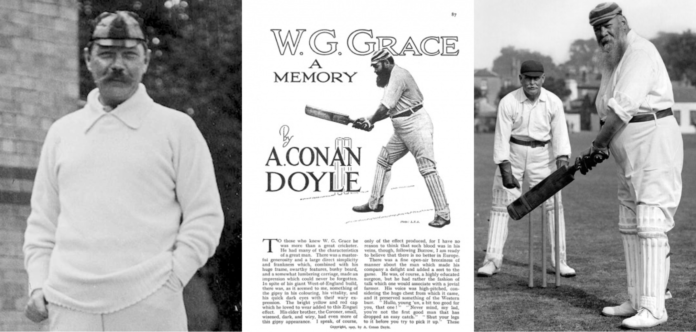


You will know Crowborough’s most famous son for his creation Sherlock Holmes. But did you know Sir Arthur Conan Doyle was also something of a cricketer – and famously took the wicket of one of the sport’s greatest ever players.
Between 1900 and 1907 the author, who lived in what is now the Windlesham Manor Care Home in Hurtis Hill, played 10 first class matches for the Marylebone Cricket Club. He only ever took one first class wicket – but what a wicket it was.
It was August 1900, and Arthur Conan Doyle prepared to bowl in a first class cricket match. At the crease was the cricketing colossus W. G. Grace who was unbeaten on 110.

Always known by his initials as “WG”, the famously bearded Grace’s first-class career spanned a record-equalling 44 seasons from 1865 to 1908. He remains widely considered as one of the sport’s greatest. But on that occasion it was Conan-Doyle who would come out on top.
Conan-Doyle later wrote about the moment he faced WG Grace in The Strand Magazine: “I was captaining an M.C.C. team upon that day — so I ventured upon an experimental over. It succeeded to a marvel.
“A half volley upon the off with all the fielders upon the off-side tempted him to sweep it round to the on. For once he got it on the edge and it went an amazing height perpendicularly into the air, and then down into the hands of Storer, the Derbyshire wicket-keeper.
“The old man laughed and shook his head at me. He was thinking probably that it was the worst ball that ever got his wicket, but he was too polite to say so.”
And so significant was the moment in the author’s life, that he turned to verse. A Reminiscence of Cricket is a poem first published in The Poems of Arthur Conan Doyle by John Murray on 21 September 1922:
Once in my heyday of cricket,
One day I shall ever recall!
I captured that glorious wicket,
The greatest, the grandest of all.
Before me he stands like a vision,
Bearded and burly and brown,
A smile of good humoured derision
As he waits for the first to come down.
A statue from Thebes or from Knossos,
A Hercules shrouded in white,
Assyrian bull-like colossus,
He stands in his might.
With the beard of a Goth or a Vandal,
His bat hanging ready and free,
His great hairy hands on the handle,
And his menacing eyes upon me.
And I – I had tricks for the rabbits,
The feeble of mind or eye,
I could see all the duffer’s bad habits
And where his ruin might lie.
The capture of such might elate one,
But it seemed like one horrible jest
That I should serve tosh to the great one,
Who had broken the hearts of the best.
Well, here goes! Good Lord, what a rotter!
Such a sitter as never was dreamt;
It was clay in the hands of the potter,
But he tapped it with quiet contempt.
The second was better – a leetle;
It was low, but was nearly long-hop;
As the housemaid comes down on the beetle
So down came the bat with a chop.
He was sizing me up with some wonder,
My broken-kneed action and ways;
I could see the grim menace from under
The striped peak that shaded his gaze.
The third was a gift or it looked it-
A foot off the wicket or so;
His huge figure swooped as he hooked it,
His great body swung to the blow.
Still when my dreams are night-marish,
I picture that terrible smite,
It was meant for a neighbouring parish,
Or any place out of sight.
But – yes, there’s a but to the story-
The blade swished a trifle too low;
Oh wonder, and vision of glory!
It was up like a shaft from a bow.
Up, up like a towering game bird,
Up, up to a speck in the blue,
And then coming down like the same bird,
Dead straight on the line that it flew.
Good Lord, it was mine! Such a soarer
Would call for a safe pair of hands;
None safer than Derbyshire Storer,
And there, face uplifted, he stands
Wicket keep Storer, the knowing,
Wary and steady of nerve,
Watching it falling and growing
Marking the pace and curve.
I stood with my two eyes fixed on it,
Paralysed, helpless, inert;
There was ‘plunk’ as the gloves shut upon it,
And he cuddled it up to his shirt.
Out – beyond question or wrangle!
Homeward he lurched to his lunch!
His bat was tucked up at an angle,
His great shoulders curved to a hunch.
Walking he rumbled and grumbled,
Scolding himself and not me;
One glove was off, and he fumbled,
Twisting the other hand free
Did I give Storer the credit
The thanks he so splendidly earned?
It was mere empty talk if I said it,
For Grace had already returned.