
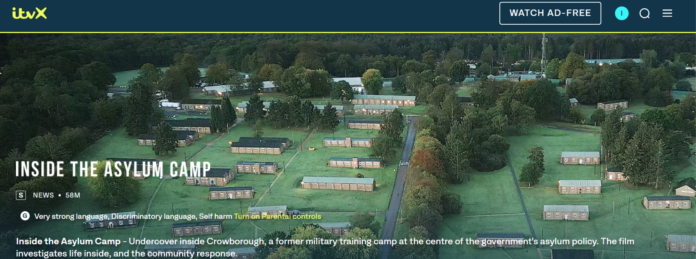


Shortcut welfare checks, torture victims, arson threats by protesters and angry abuse – behind the scenes and undercover at Crowborough Army Training Camp with ITV.
An undercover report has shed new light on life in Crowborough’s Army Training Camp and how the housing of hundreds of asylum seekers is being managed.
ITV broadcast the documentary “Life in the Camp” using footage secretly filmed by an undercover reporter to expose how the camp is being run by the Home Office and its contractor Clearsprings, but also the activities of some extreme protesters.
Following a vetting process that took several months, the reporter got a job as a welfare officer and the resulting footage was aired as part of the documentary on 15 November.

The programme told the story of how the camp had come to be used to house asylum seekers, the protests that had followed, the anger of local people at how it had come about, and concerns expressed about the impact on the town and residents’ safety.
Serious incidents of rape and sexual assault involving asylum seekers in other parts of the country were cited as reasons for local concerns. The documentary said local people were concerned about safety and feared the town was too small to cope.
So what did we learn? Below we have tried to impartially summarise the key issues raised in the documentary. ITV used the names of individuals which we have chosen not to repeat.
Welfare Checks
Possibly the most significant and concerning outcome from the documentary was the short cuts being taken with welfare checks. Footage showed how the checks – meant to take place twice a month for each asylum seeker and involve nine questions and an in-depth conversation, were not being done properly.
The reporter, with only three days online training and no on-the-job training, shadowed a welfare officer who asked just three questions of one asylum seeker and explained to the reporter “you don’t need to go in too deep”.
With 1,000 welfare checks to be done a month, even with the shortcuts, the process is well behind. The ITV reporter posing as a welfare officer was told: “We’re so f*cked”.
Protests, monitoring and patrols
As well as the Crowborough Aware patrols, we learnt that a network of CCTV cameras and an early warning system was in place with concerned residents keeping an eye on the asylum seekers who are free to move around and, under law, cannot be detained.
Crowborough Aware told the film makers they had people monitoring camp entrances and exits. They were not as vigilantes but “to make sure they’re passive, not a problem”. One group they approached and questioned were from Iran and Iraq and the exchange was pleasant. “They were fine, he was a nice chap.” One patroller said.
While they themselves were watching a group of asylum seekers buying caffeine drinks inside Lidl, the patrol volunteers were concerned about someone filming them from the forecourt of Morrisons garage. “There’s someone taking a picture of us there, for some reason.”
And one patrol member appeared on the film apparently not understanding how the asylum process works. She said she didn’t know why they hadn’t “applied using the legal channels”. “Can’t you apply outside and ask to come to the UK?” The reporter clarified that you have to get to a country first before you can claim asylum.
Isolation
An isolation block is being used to keep asylum seekers suspected of having disease away from others. However, the programme suggested people were being held here too long, after they had been given the all-clear. The programme showed how one asylum seeker had jumped from a window and fled. He had later been found.
Torture victims and safeguarding
Most of the asylum seekers are from countries such as Sudan, Somalia, and Eritrea and are fleeing war. The undercover reporter just on his own discovered at least five who had experienced torture and were being housed at Crowborough in the dormitories. Home Office guidelines say torture victims should not be held in groups. The undercover reporter was told the “safeguarding” flag on asylum seeker records “means nothing”.
Public attitudes
The documentary covered the weekly protests and the concerns raised by residents – including those at the fiery public meeting at which the Home Office was criticised.
One resident told the programme she wouldn’t be able to go out walking on her own any more, and another said there were now “no-go areas for white people” in this country… “and I think that’s very scary”.
Most of the concerns raised were about different cultural attitudes to women, and different attitudes to those in the UK.
But there were other views. One was volunteering and helping with a group taking some asylum seekers on walks across the Ashdown Forest. She said: “There was a lot of talk about a crime wave and how they would be raping and pillaging…but they are just people, just like the rest of us.”
Suspected rapist
One camp resident was found to have been at the Crowborough camp for two months before it was realised he was wanted in connection with a rape in Germany.
Mustafa
The ITV programme highlighted how there had been anger and abuse on Facebook when protesters posted a photo of an asylum seeker apparently working with Coppards on road repairs. Asylum seekers are not allowed to do paid work. The undercover reporter discovered Mustafa, whose father had been killed in the war in Sudan, was actually doing legal unpaid work experience arranged by the camp. Unfairly criticised, Coppards had to release a statement. Now in the north of England, Mustafa had been a civil engineering student and graduate in Sudan before he fled the conflict. He has had his asylum application approved and has been allowed to stay.
Mermaid Dental Practice
Again social media played a part in a situation involving Mermaid Dental Practice. Learning that it was assisting asylum seekers with treatment, protesters encouraged patients to express their concern. The firm, who declined to comment to the programme makers, withdrew the service and said it had had threats and abuse and was doing so to protect staff.
The documentary said the NHS had confirmed the practice had been receiving threats since the beginning of May and made the decision to stop treatment for asylum seekers when it received threats of an arson attack.
Volunteer walkers
The programme showed the walking group and how protesters had identified women volunteering – and then used Facebook to make obscene and abusive comments targeted at the volunteers including “you should be raped”.
Cost of transfers
The programme revealed it costs £1.50 a mile to taxi the asylum seekers on to their next placement. One trip, with an overnight stay, had cost the taxpayer £900.
Response statements:
Crowborough Says No said: “Extreme comments made by members of the public do not represent the group’s views, and such comments are removed when they are reported.”
Home Office said: “We take our responsibilities towards the well-being of asylum seekers extremely seriously, and will investigate any allegations thoroughly. Welfare checks are a vital tool to assess well-being for all individuals on site. We expect the highest standards from our staff and contractors, and frequently assess the delivery of these. Isolation facilities are provided in line with UK health security agency guidance. This is not detention, and individuals are not prevented from leaving or accessing additional support. The government is working on a fairer distribution of asylum accommodation across the country. We continue to work closely with local authorities, police, health partners, and community representatives to manage this site effectively, and address local concerns.”
Clearsprings said: “Welfare checks at Crowborough are carried out regularly, and in accordance with the relevant applicable standards. We reject the allegation that welfare officers conducted substandard welfare checks that they are understaffed or cut corners to meet monthly targets.”
“There is no safeguarding risk. We aim to conduct fortnightly welfare checks, which is consistently achieved. The Home Office only requires one check per month. Welfare check numbers are provided to the Home Office who regularly sample their content, and they have raised no concern about either their frequency or quality. Translation services are available when required and on demand.
“We are not aware of any failings relating to key questions, service users (Sus), are asked during a welfare check, and the software system in place requires answers to all 9 key questions. Confidential spaces are offered and used for welfare checks unless SUs are happy for them to take place elsewhere.
“Welfare staff ask service users, SUs, about their mental health and service users are signposted to the on-site medical team when concerns are raised. It is not the responsibility of the welfare team to confirm an SU suitability for Crowborough – that has been determined that has been determined before they arrive.
“Welfare checks are not designed to specifically query torture, though any flags prompt further questions, and any suitability concerns are escalated to the home office to assess. Where, relocations are found necessary, the service user in question is relocated immediately. Service users are regularly referred to the medical centre, and individual safety plans are created and shared with the welfare team. Proactive inquiries and routinely refer SUs to the home office.
“Service users are not imprisoned and conditions in the isolation unit do not breach any rights under the human rights act. Single rooms in isolation are used for individuals with infectious diseases. Service users are advised not to engage with the wider population because of the risk of spreading infectious diseases. Entry and decisions are made by the on-site medical centre as approved by the home office and the UKHSA. Security escorts to toilet, shower facilities, and movement restrictions follow home office protocols to manage infection risks.
“We have no record of anyone jumping from windows and security staff have never been instructed to use force. Running water is present in the isolation block, but there is no drinking water. Multilingual posters in form service users, they can request additional refreshments anytime from the security officer. We do not accommodate service users outside Wales and Southern England, so journeys outside these areas are not for clear springs to comment.”