
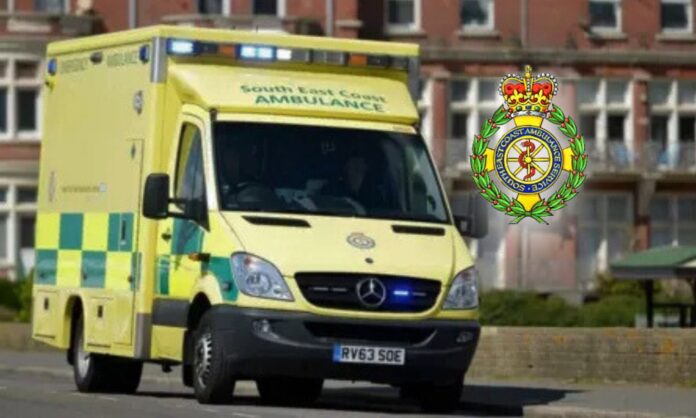


SOUTH East Coast Ambulance Service NHS Foundation (SECAmb) has welcomed latest figures which show it is meeting the response time target to respond to some of its most seriously ill and injured patients.
But it has also admitted it needs to do more to improve response times across all categories of calls for help. And it is only beating the response time average because the Govt adjusted it to give ambulances more time.
Target changed
SECAmb was one of only a small number of ambulance trusts to exceed the Category 2 call performance target across the whole last 12-months, (1 April 2024 – 31 March 2025) with a yearly average response time of 28 minutes and 49 seconds. The average response time target is 30 minutes – changed from 18 minutes.

SECAmb said it beat this 30 minute target despite a close to 40,000 increase in 999 calls on the previous year. Category 2 includes calls to suspected stroke and heart attack patients and is where some two-thirds of SECAmb’s calls fall.
But SECAmb said it knows it has to improve response times across all categories of calls and is making further improvements to ensure patients receive the most appropriate response for their needs.
New clinical hubs
The work includes the introduction of an additional five multi-discipline clinical hubs. The Unscheduled Care Navigation Hubs (UCNHs) see SECAmb’s highly-skilled clinicians joined by specialist teams from across local healthcare systems to ensure 999 calls are receiving the most appropriate response. The hubs complement SECAmb’s existing urgent care hubs, through which the Trust’s Advance Paramedic Practitioners (APPs) provide support and advice to ambulance crews.
The hubs are just one way SECAmb is aiming to improve its ‘Hear and Treat’ rate – the number of calls which are handled with advice over the phone or via referral to another service rather than receiving a face-to-face ambulance response. The rate currently stands at more than 15.6 per cent, up more than 5 per cent since 2023.
Much to do
SECAmb Chief Executive, Simon Weldon said: “We delivered a really consistent Category 2 response time performance across the past 12 months. This is a challenging category for all ambulance services as it is where a majority of our calls fall.
“Teams right across our organisation are responsible for ensuring we exceeded this target. They should all be very proud and I would like to thank all our staff and volunteers for their work in achieving this target.
“We are very aware that there remains much to do to ensure we continue to make improvements across all categories of call. Measures that we have implemented, including the introduction of more of our multi-discipline clinical hubs, are proving beneficial for patients.”