
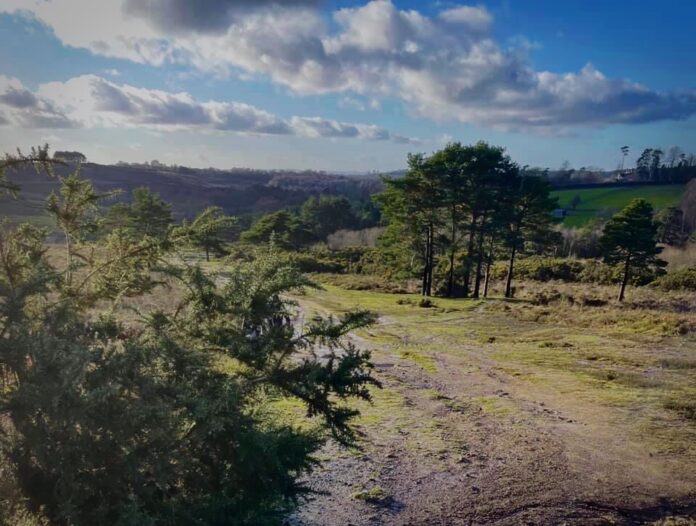


Unless you have been living under a rock for the past few months, you will know Ashdown Forest’s famous association with the world’s most beloved bear, Winnie-the-Pooh.
It was here, of course, that the loveable “bear of little brain” who has just celebrated his 100th birthday, was created by AA Milne.
But there’s much about Ashdown Forest that maybe you didn’t know. We set out to find out some other interesting facts and stories about the wonderful and unique landscape on our Crowborough doorsteps…

King’s Standing
Did you know that the forest was a favourite hunting ground for King Henry VIII? Staying at Bolebrook Castle while apparently wooing Anne Boleyn at her home at Hever Castle, the fearsome monarch was a regular visitor to the forest. A “standing” was an elevated platform or look out position used by the nobility to shoot at deer which were driven from nearby enclosures past the site. This was Henry’s favourite hunting spot, hence “King’s” standing.
A thousand years of history (almost)
The Ashdown Forest does not appear to have existed before the Norman conquest led by William the Conqueror in 1066 and is not mentioned in the Doomsday Book which mapped out all the land in the country. However, records do suggest it was established as a medieval hunting ground very soon after the Norman invasion. The first recorded reference to Ashdown Forest by name is in the period 1100–1130, when Henry I confirmed the right of monks to use a road across the forest of “Essessdone”.
Beyond “The Pale”
Although open countryside today, in the late 13th Century the forest was surrounded by a 23-mile staked fence and ditch, known as a “pale”. This completely enclosed the forest keeping the deer inside, and parts of the ditch can still be seen in the landscape today. If you get the chance check out Tony Robinson’s “Walking Through History” TV programme which features the forest and tells the story of the pale – as well as the industrial centre it would become.
“Hatches” and “Gates”
Have you ever wondered how places like Chuck Hatch, Chelwood Gate, and Coleman’s Hatch get their name? Hatches and Gates were the access points in the “pale” which allowed people in and out of the fenced off forest. In total there were 34 of them – gates were larger to allow for wagons and carts, while hatches were smaller for pedestrians. These access points allowed local people to enter to graze their livestock, collect firewood, and cut heather and bracken for animal bedding.
“Ash”down – so why so few ash trees? And “Forest” – why no large area of woodland?
Ashdown has nothing to do with ash trees. Ashdown, is actually Anglo Saxon and it is thought it probably comes from the personal name of an individual or people called Æsca, combined with dūn, Old English for hill or down, hence Æsca’s dūn—the hill of Æsca.
Meanwhile “Forest” does not mean a large area of dense woodland. It was a term used by the Normans to denote land that was subject to “forest law”, a harsh and much resented law that was designed to protect, for the king’s benefit, the animals and wildlife of the area. However, while forest land was legally set aside by the crown for hunting, commoners were still able to exercise many of their traditional or customary rights (hence the hatches and gates).
The birthplace of the iron industry
Yes, you read that correctly. The first iron ore blast furnaces were not in industrial northern England as we might guess, but in the Weald and on Ashdown Forest. The second iron ore blast furnace in the country was set up in 1496 at the bottom of Kidd’s Hill near Coleman’s Hatch (the first dates from 1490 near Buxted). At one stage there were more than 100 such furnaces extracting iron across the forest and the wider Weald area.
But the extraction of the iron actually dates back much earlier. When the Romans invaded England in AD43 iron furnaces and extraction were already commonplace across the Weald which was the main iron-producing region of Britain in the first 200 years of the Roman occupation (1st to 3rd centuries AD) and then during Tudor and early Stuart times.
Look in the streams and wet areas of the forest and around Crowborough and Rotherfield and more often than not you’ll see the orange evidence of iron in the landscape.
William Cobbett – was he in the right place?
William Cobbett was a well-known English pamphleteer, journalist, politician, and farmer possibly best known for his book “Rural Rides”. He embarked on a series of journeys by horseback through the countryside of Southeast England and the Midlands to capture a picture of rural life – both from the perspective of a farmer and a social reformer.
And while today we marvel at the astonishing beauty of our Ashdown Forest, it is fair to say Cobbett was less impressed:
“At about three miles from Grinstead you come to a pretty village, called Forest-Row, and then, on the road to Uckfield, you cross Ashurst [sic] Forest, which is a heath, with here and there a few birch scrubs upon it – verily the most villainously ugly spot I saw in England. This lasts you for five miles getting, if possible, uglier and uglier all the way, till, at last, as if barren soil, nasty spewy gravel, heath and even that stunted, were not enough, you see some rising spots, which instead of trees, present you with black, ragged, hideous rocks.”
Well, so much for Cobbett.
The Clumps
While the “clumps” of conifer trees are a familiar sight in the forest landscape, they are a relatively recent addition. Planting began on the elevated parts of the forest in 1825, commissioned by the then owner, Elizabeth Countess de la Warr. At the time locals were opposed to this artificial addition to the historic forest and numerous trees were cut down by protestors. There are now, though, 12 clumps marking way points in the 32-mile route challenge. The last to be planted was the Millennium Clump near the forest centre. Before that it was Friends’ Clump in 1973 – planted by the Friends of the Forest to mark national “Year of the Tree”.
A properly “special” place for nature
We really shouldn’t take the Ashdown Forest nor its protection for granted. It is internationally recognised as being of significance with its lowland heathland being rarer globally than tropical rainforests. The forest is a “Site of Special Scientific Interest” (SSSI), a “Special Protection Area” (SPA) for birds, and a “Special Area of Conservation” (SAC) for its habitats. It is home to numerous rare and unusual species of plants, animals and insects. For birdwatchers it is one of the few places in the UK you can see hear (and see, if you’re really lucky) the Dartford Warbler and the nightjar. If you need any more convincing, Charles Darwin stayed in Hartfield and studied the forest’s carnivorous plants for his 1875 book, “Insectivorous Plants”.
So next time you’re on the forest in search of Pooh or any of his friends, think of Henry VIII and Anne Boleyn, imagine an industrial iron blasting landscape, keep an eye open for evidence of the pale, consider whether you agree with William Cobbett, and reflect on how lucky we are to have such an internationally “special” place on our doorstep.