
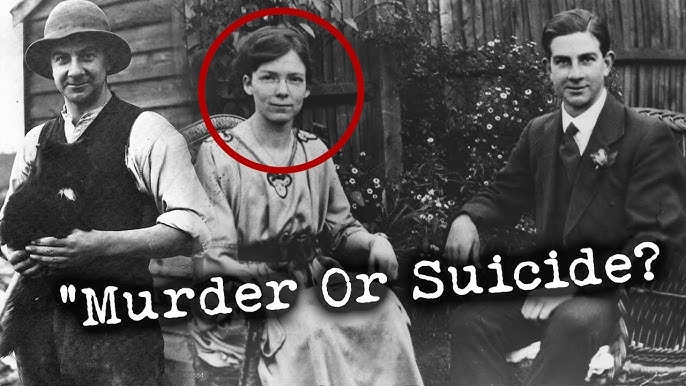


Just over a hundred years ago Crowborough hit the national headlines for all the wrong reasons when an apparently hard-working Sunday School teacher and Chicken farmer, murdered his fiancé and dismembered her body.
Involving a tragic love triangle, the case attracted attention from across the UK and has become known as the Chicken Run Murder.
Norman Thorne and Elsie Cameron met in 1920. She was a 22-year-old typist he, just 18-years-old, was an electrical engineer. He was also a Sunday school teacher from Kemsal Green, London.

At the time it was expected that young women would marry and bring up a family and, apparently, Elsie was worried that if she did not find a man soon she would end up left on the shelf – so she set her eyes on Norman and their relationship began.
When Norman became unemployed in the summer of 1921 he decided to go into business for himself. With £100 given to him by his father, he bought a small piece of land in Luxford Lane and began the Wesley Poultry Farm.
By all accounts Norman worked hard on this new venture. He built a series of sheds and runs and remarkably cycled back to London at weekends to see Elsie. He then converted one of the shacks on the site into living accommodation and moved in. That meant no need for any more cycling and so, instead, Elsie would catch the train down to Sussex. She would spend the days with Norman and lodge with a local family at night.
Elsie and Norman became engaged at Christmas 1922 and everything seemed rosy for the couple. But then things started going wrong. Shortly afterwards Elsie, who suffered mental health problems described as “her nerves”, lost her job. Over the next few months she had a series of jobs, all of which she soon left, for one reason or another. To make matters worse, despite his hard work, Norman’s business wasn’t doing too well. Because of this Norman was reluctant to fix a wedding date.
And then things took what would eventually turn out to be a fatal turn. At Whitsun 1924 Norman went to a local dance and met another woman, Bessie Coldicott, a dressmaker. Bessie was a lot less demanding and uncomplicated. His feelings began to shift from Elsie to the fun-loving Bessie.
In October 1924 Elsie travelled to Crowborough and stayed a week. As usual, she lodged with Norman’s neighbours, Mr and Mrs Cosham, and spent her days at the farm. After she returned home she wrote to Norman informing him that she was pregnant. Norman promptly wrote back telling her about Bessie. Elsie replied the following day, telling him that he had got her pregnant and she expected him to marry her before Christmas. But Norman’s affections were very much elsewhere.
Norman wrote to Elsie: “There are one or two things I haven’t told you for more reasons than one. It concerns someone else as well … I am between two fires.”
Elsie seemed to not understand and wrote back to Norman insisting they should marry as soon as possible. So Norman replied more explicitly: “What I haven’t told you is that on certain occasions a girl has been here late at night. I am not going to mention her name. No one knows … I must have time to think, she thinks I am going to marry her, and I have a strong feeling for her.”
Elsie was distraught but determined not to lose her man. She replied: “You have absolutely broken my heart, I never thought you were capable of such deception…Your duty is to marry me. I have first claim on you. I expect you to marry me as soon as possible. My baby must have a name, and another thing, I love you in spite of all.”
And so it was that in early December 1924, Elsie set off for Crowborough. She bought her ticket and boarded the train in the third class carriage. Arriving, she walked to the farm.
It was the last time she was seen alive.
Days passed and her family grew concerned. Her father wired Norman several times and he replied. He claimed she had disappeared and he couldn’t understand why. Elsie’s father informed the police of his daughter’s disappearance.
It was established that Elsie had been seen, by two flower-growers, carrying an attaché case while walking towards the farm at. When police officers spoke to Norman he was adamant that she had not been to the farm.
At the beginning of January there was still no sign of the missing woman. Police paid a visit to one of Norman’s neighbours, Mrs Annie Price. She was certain she had seen Elsie entering the farm on the day she had vanished. Sussex police requested assistance from Scotland Yard and Chief Inspector Gillan arrived to take over the case.
After reviewing the evidence they had Chief Insp Gillan decided there was enough to arrest Norman. The farm was searched and, in a tin, they found Elsie’s watch, bracelet and some jewellery. Having completed their search of the outbuildings on the farm they now started to dig. The next morning they unearthed Elsie’s case.
Norman changed his story. He told detectives that he hadn’t killed Elsie but knew where she was buried. He admitted she had been at the farm that day. She had been upset and refused to leave until they were married. He told police he had explained about his feelings for Bessie and they had argued. He had already agreed to meet Bessie and her mother at the station and he left to meet them leaving Elsie at the farm.
Norman told the investigators that when he returned he found Elsie had used his washing line to hang herself from a beam. He had cut her down and then just sat down and thought about what he was going to do. He said he got his hacksaw, and sawed off her legs, and her head. He had then buried the pieces under the chicken run.
His story appeared to unravel, however, when Sir Bernard Spilsbury, carrying out the post mortem, said that he could find no sign of rope marks.
Norman was charged with murder.
He appeared before Lewes Assizes on 4th March 1925. Evidence was given as to the lack of rope marks for the prosecution. The defence argued they had found creases on the neck that may have been made by a rope. But the police said their examination of the beams in the shack had shown no sign of a rope having been suspended.
On the 16 March Norman was found guilty and sentenced to death.
The case received considerable press coverage. Many people, including Sir Arthur Conan Doyle, thought that the trial had not proved ‘beyond reasonable doubt’ that Norman had killed, or meant to kill, Elsie.
An appeal was lodged in March 1925, but it was dismissed the following month. Norman was hanged on 22 April 1925 in Wandsworth prison in London on what would have been Elsie’s 27th birthday.
Sources: www.Real-Crime.co.uk, BBC, Wikipedia, Memories of Crowborough & Rotherfield Facebook page.
In 2019 the case was examined by Murder, Mystery and My Family, a BBC One series featuring Sasha Wass KC and Jeremy Dein KC., which examined historic criminal convictions resulting in the death penalty in order to determine if any of them resulted in a miscarriage of justice. It featured Gordon Owers and Helen Frost who, having learned about this sinister chapter of their family history were keen to learn more about the case. Unfortunately, we’ve not been able to find footage of the programme but apparently the outcome was that the verdict was upheld.